
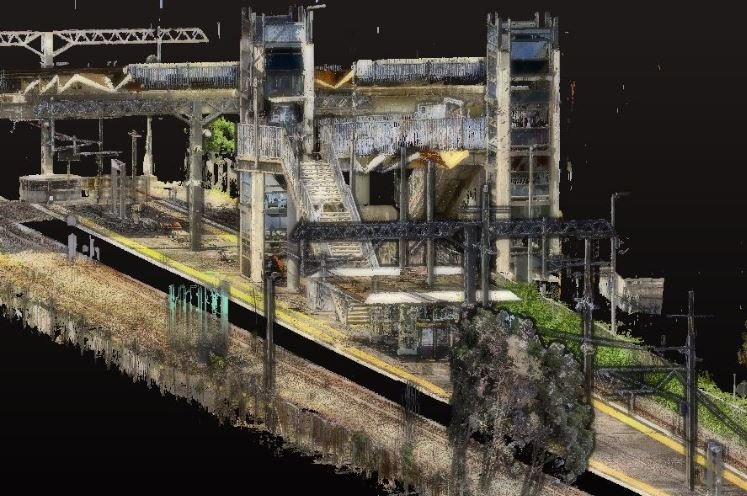
Recon carries out 3D point cloud surveys of buildings, plant, structures and land across Auckland and New Zealand. We capture millions of measured points with FARO terrestrial laser scanners or drone LiDAR, register them into one accurate 3D dataset, and deliver it ready for your design or asset team, usually within 3–5 working days of the scan.
What is a point cloud survey?
A point cloud survey records the shape and position of everything a scanner can see as millions of individual 3D points, each with a measured X, Y and Z coordinate and usually a colour. Together they form a “point cloud”: a precise digital copy of a building, plant room, bridge or site that you can measure, section and model from, without going back to site.
Two ways we capture a point cloud
Terrestrial laser scanning is best for buildings, plant rooms, structures and interiors. FARO scanners on tripods capture detail to better than 2 mm point-to-point accuracy, and we often run two scanners at once to cut time on site. More about 3D laser scanning.
Drone LiDAR is best for land, corridors, solar farms and large sites. Our drone LiDAR captures 300–400 points per square metre, sees through gaps in vegetation to the ground, and covers many hectares in a day. More about drone LiDAR surveys.
Many projects combine the two, for example scanning a building with tripods and its roof and surrounding site from the air, all tied into one coordinate system.
What you receive
A registered point cloud in the format your software needs: Autodesk ReCap (RCP/RCS), E57, or LAS/LAZ
Scene2Go walk-through viewer: explore and measure the scan on any Windows PC, with no licence needed
Classified LiDAR (drone surveys): ground, vegetation, buildings, poles and conductors
Coordinates tied to NZTM2000 and NZVD2016, or your project grid
Optional outputs from the point cloud: plans, sections and elevations, topographic surveys and contours, DTM/DEM, CAD drawings and Revit models through scan-to-BIM
How accurate is a point cloud survey?
It depends on the capture method:
Terrestrial laser scanning: better than 2 mm point-to-point at 10 m. Registered scans are checked against survey control where accuracy matters.
Drone LiDAR: better than ±50 mm vertical and ±100 mm horizontal on hard surfaces.
We confirm the accuracy you need when we scope the job, and tie the survey to survey control when your project requires it.
Who uses point cloud surveys?
Architects and designers: existing-conditions information for alterations, fit-outs and heritage work
Engineers: structural, civil and services
Project managers and contractors: as-built checks and coordination
Asset owners: treatment plants, pump stations and industrial sites
Councils
Solar and land developers: site design
Frequently asked questions
How long does a point cloud survey take?
Most buildings are scanned in a few hours to a day or two on site. Drone LiDAR covers many hectares in a day. Registered point clouds are usually delivered within 3–5 working days.
Can the point cloud be tied to survey coordinates?
Yes. We set survey control and tie the point cloud to NZTM2000 and NZVD2016, or to your project grid, so it lines up with other survey and design data.
What software can open the files?
Autodesk ReCap, Revit, AutoCAD, Civil 3D, Navisworks and most GIS and point cloud software read our formats. Scene2Go lets anyone view and measure the scan without specialist software.
How much does a point cloud survey cost?
It depends on the size and complexity of the site, the capture method, the accuracy required and the outputs you need. Tell us about your project and we’ll give you a clear scope and quote.
Get a point cloud survey quote: send us the address, the area to capture and what you need the data for. Contact us.